Starting a self-study library is much more than renting a hall, buying chairs, and waiting for students to arrive. It is about creating an environment where students can focus, prepare for competitive exams, and achieve their goals. For entrepreneurs, it is also an opportunity to build a sustainable business that serves a growing demand for quiet, professional study spaces.
Across India, the number of students preparing for UPSC, SSC, Banking, Railways, State PSCs, CA, CS, NEET PG, GATE, and other competitive exams continues to grow. Many of these students cannot study effectively at home because of distractions, limited space, or an unsuitable environment. A well-managed self-study library solves that problem.
At the same time, many aspiring entrepreneurs are attracted to the business because it appears simple to start. Unfortunately, this often leads to costly mistakes. Some invest heavily in interiors before understanding local demand. Others choose poor locations, overcrowd the study hall, or compete only on price. These decisions can affect profitability long before the first student walks through the door.
This guide is designed to help you avoid those mistakes.
Unlike many articles that provide only basic tips, this guide is based on practical experience running a successful self-study library and building technology specifically for library owners. The goal is to help you make informed decisions, deliver a better student experience, and build a business that can grow over time.
Whether you are planning your first library or looking to improve an existing one, this guide will walk you through every major stage—from research and planning to operations and expansion.
Table of Contents
- What Is a Self-Study Library?
- Is the Self-Study Library Business Profitable?
- Who Should Start a Self-Study Library?
- Step 1: Research Student Demand
- Step 2: Choose the Right Location
- Step 3: Plan Your Investment
- Step 4: Design a Premium Study Environment
- Step 5: Create the Right Pricing Strategy
- Step 6: Get Your First 100 Students
- Step 7: Run Your Library Professionally
- Step 8: Expand Beyond One Branch
- Common Mistakes to Avoid
- Frequently Asked Questions
- Conclusion

What Is a Self-Study Library?
A self-study library is a dedicated study space where students can bring their own books and learning materials while benefiting from a quiet, comfortable, and distraction-free environment.
Unlike traditional public libraries, self-study libraries usually do not lend books. Instead, students pay a membership fee to access facilities that help them study more effectively.
Typical facilities include:
- Comfortable seating
- Spacious study tables
- Air conditioning
- High-speed Wi-Fi
- Individual charging points
- CCTV surveillance
- Clean washrooms
- Drinking water
- Quiet study zones
- Lockers (optional)
The business model is simple.
Students pay for access to an environment that improves concentration and productivity.
As competition for government jobs and professional courses continues to increase, demand for high-quality study spaces has grown significantly across many Indian cities.
Founder Insight
One of the biggest misconceptions about this business is that students pay for a chair.
They don’t.
They pay for the ability to study without distractions.
When a student chooses your library, they are buying focus, discipline, comfort, and peace of mind.
Everything you do should improve that experience.
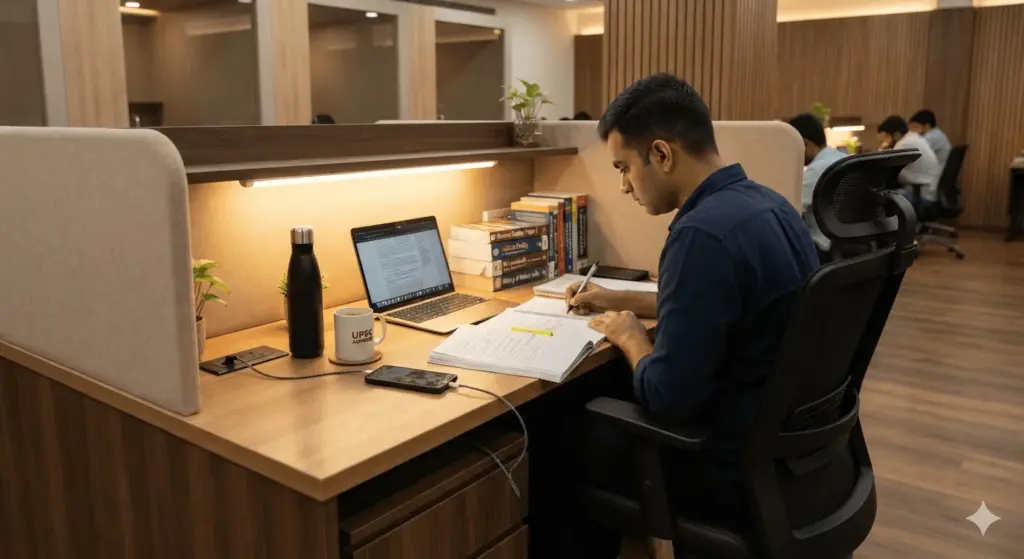
Students spend many hours at a single seat. Comfort directly influences satisfaction and retention.
Why Is the Self-Study Library Business Growing in India?
Several factors are driving demand for self-study libraries.
Rising Competition
Every year, millions of students prepare for competitive examinations.
Competition has increased while available government positions remain limited.
Students are studying longer hours than ever before.
Home Is Not Always the Best Study Environment
Many students live in:
- Joint families
- Shared apartments
- Paying guest accommodations
- Hostels
Noise, interruptions, and limited personal space reduce concentration.
A professional study environment becomes a valuable alternative.
Demand for Better Study Experiences
Today’s students expect more than a basic reading room.
They value:
- Comfortable seating
- Clean surroundings
- Reliable internet
- Good ventilation
- Quiet atmosphere
- Professional management
Libraries that consistently deliver these experiences often build strong reputations through word-of-mouth and online reviews.
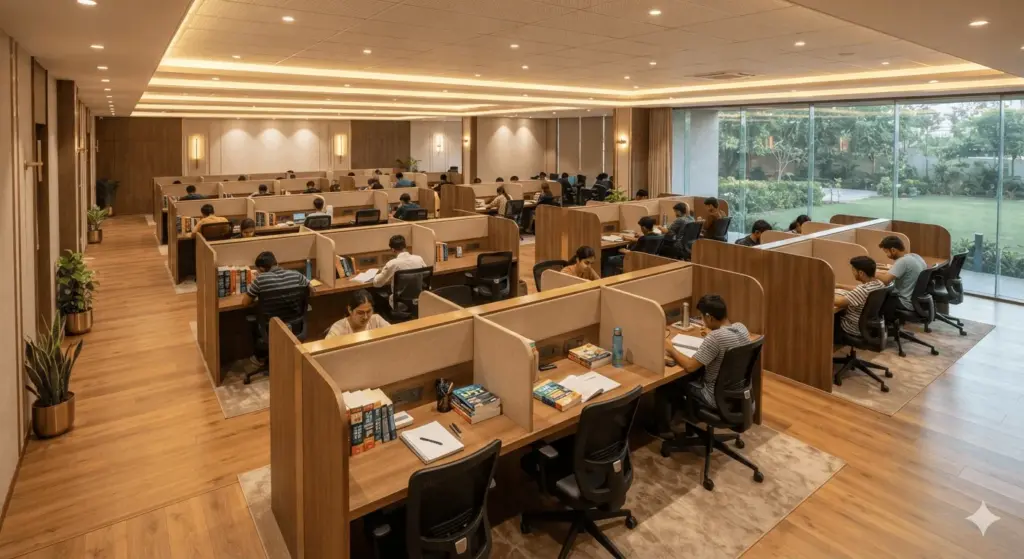
A spacious, distraction-free environment encourages longer study sessions and higher student satisfaction.
Is the Self-Study Library Business Profitable?
Yes—but profitability depends on planning, execution, and consistent operations.
Many people assume that opening a library automatically leads to steady income.
The reality is more nuanced.
Successful libraries focus on:
- Understanding local demand
- Choosing the right location
- Creating a premium student experience
- Pricing appropriately
- Maintaining high occupancy
- Controlling operating expenses
Libraries that ignore these fundamentals often struggle, regardless of how attractive the interiors may be.
Founder Principle #1
Never Compete Only on Price
Many new owners believe that offering the lowest membership fee will attract more students.
In practice, this often creates unnecessary price competition and reduces profitability.
Instead, focus on delivering a noticeably better experience.
Students are often willing to pay more for:
- Better chairs
- More personal space
- Cleaner facilities
- Reliable management
- Consistently quiet study areas
When students clearly see the value, price becomes less important.
Comparison Table
| Low-Cost Library | Premium Library |
|---|---|
| Basic furniture | Comfortable ergonomic seating |
| Maximum seat density | Spacious layout |
| Limited maintenance | Daily cleanliness |
| Minimal student support | Professional management |
| Price-focused | Experience-focused |
Premium design creates a better learning experience and supports premium pricing.
Who Should Start a Self-Study Library?
This business is suitable for entrepreneurs who enjoy building organized, service-oriented businesses.
It may be a good fit if you:
- Want to build a recurring revenue business
- Can manage day-to-day operations consistently
- Are willing to invest in quality rather than shortcuts
- Enjoy improving customer experiences
- Think long-term rather than looking for quick returns
It is not ideal if you expect the business to run successfully without systems, maintenance, or ongoing attention.
Action Checklist
Before moving to the next step, ask yourself:
- Do I understand why students use self-study libraries?
- Have I identified the type of students I want to serve?
- Am I prepared to compete on experience rather than price?
- Do I view this as a long-term business?
If you answered “yes” to these questions, you’re ready for the most important stage of the journey:
Understanding real student demand before investing any money.
Step 1: Research Student Demand Before You Invest
Every successful self-study library begins with one thing:
Demand.
It doesn’t matter how beautiful your interiors are or how much money you’ve invested. If there aren’t enough students looking for a quality study environment in your area, your business will struggle.
One of the biggest mistakes new entrepreneurs make is falling in love with a building before confirming whether there are enough potential customers nearby.
A better approach is to validate demand first and invest second.
Founder Principle #2
Never Fall in Love with a Property Before Validating Demand
Many people find a vacant commercial space, imagine how attractive it will look as a library, sign a long-term lease, and only then begin wondering how they’ll attract students.
Reverse that process.
Start by understanding the market.
If the demand is strong, you’ll find another building.
If the demand is weak, even the perfect building won’t save your business.
Who Are Your Target Students?
Before researching your competitors, identify exactly who you’re planning to serve.
Different student groups have different expectations.
Your potential customers may include:
- UPSC aspirants
- SSC students
- Banking exam candidates
- Railway exam candidates
- State PSC aspirants
- CA and CS students
- NEET PG students
- GATE aspirants
- University students
- Working professionals preparing for competitive exams
Each group influences your location, pricing, operating hours, and facility requirements.
For example, students preparing for UPSC often spend 8–12 hours a day studying and usually value silence, comfort, and consistency. University students, on the other hand, may use the library for shorter sessions and place greater importance on affordability and proximity to campus.
Understanding your primary audience helps you design a library that truly meets their needs.
Understanding your target audience helps you create a study environment that matches their expectations.
How to Research Your Local Market
Before investing a single rupee, spend time understanding your local market.
Your objective is to answer three questions:
- Is there enough student demand?
- How strong is the competition?
- Can I offer a better experience than existing libraries?
The easiest way to begin is with online research.
Use Google Maps
Search for:
- Self Study Library Near Me
- Reading Library Near Me
- Study Library
- Library Near Me
Google Maps will show existing libraries in your area.
Create a spreadsheet and record:
| Research Point | Notes |
|---|---|
| Library Name | |
| Location | |
| Google Rating | |
| Number of Reviews | |
| Membership Price | |
| Facilities Offered | |
| Operating Hours | |
| Strengths | |
| Weaknesses |
This simple exercise gives you a clear picture of your local market.
Don’t Research Only Online
Google provides useful information, but it doesn’t tell the whole story.
Visit your competitors personally.
Observe:
- Is the library full?
- What type of students are studying there?
- How clean is the facility?
- How comfortable are the chairs?
- Is there enough spacing between seats?
- How professional is the reception?
- How are visitors greeted?
Many opportunities become obvious when you see the business in person.
Founder Insight
One lesson I learned early is that students notice details owners often ignore.
A clean washroom.
A stable internet connection.
Comfortable seating.
Quiet surroundings.
These small details often determine whether a student renews their membership.
Never underestimate the value of observing competitors carefully.
Read Every Google Review
Google Reviews are free market research.
Positive reviews tell you what students appreciate.
Negative reviews tell you exactly where competitors are failing.
Look for patterns such as:
- Poor cleanliness
- Uncomfortable chairs
- Noise complaints
- Slow management response
- Weak internet
- Parking problems
Each repeated complaint represents an opportunity for your business.
Instead of copying your competitors, solve the problems they haven’t solved.
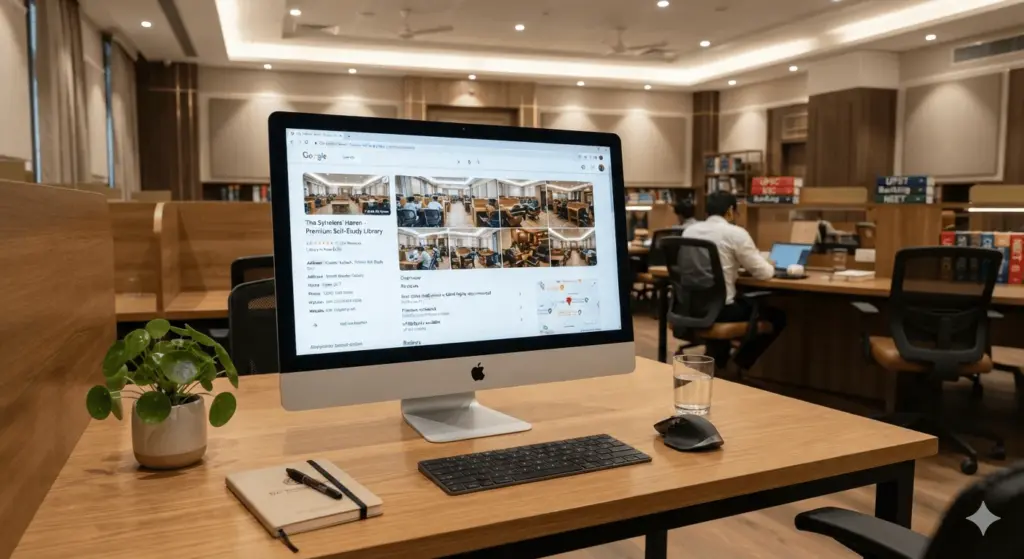
Google Reviews reveal what students value most—and where competitors are falling short.
Understand Local Pricing
Pricing research is about much more than knowing what competitors charge.
It helps you understand:
- Student spending capacity
- Market expectations
- Premium positioning opportunities
Visit multiple libraries and record:
- Monthly membership fee
- Security deposit (if applicable)
- Registration charges
- Available plans
- Premium seating options
Then ask yourself:
If I improve the experience, can I confidently charge a little more?
Remember:
Your goal is not to become the cheapest library.
Your goal is to become the best value.
Founder Story
When I started my own library, nearby competitors were charging approximately ₹400–₹600 per month.
Many people suggested I should charge less.
Instead, I invested in creating a better experience.
I opened at ₹600.
As students recognized the value, I gradually increased the fee to ₹700 and later ₹800.
Students stayed because they believed the experience justified the price.
That experience completely changed how I think about pricing.
Competing on quality is far more sustainable than competing on discounts.
Action Checklist
Before signing a lease, complete these tasks:
- ✅ Search for all competing libraries on Google Maps.
- ✅ Visit at least five libraries in person.
- ✅ Record membership pricing.
- ✅ Read at least 100 Google Reviews across competitors.
- ✅ Identify the five most common student complaints.
- ✅ Define what will make your library different.
Once you’ve completed this research, you’ll have a much clearer understanding of your market—and you’ll be ready to choose a location with confidence.
Step 2: Choose the Right Location for Your Self-Study Library
If market research tells you whether you should open a library, location determines whether it succeeds.
A great location can reduce your marketing costs, increase occupancy, and help you build a strong reputation much faster.
A poor location can make even the best-designed library struggle.
Many new entrepreneurs choose a property because:
- The rent is low.
- The building looks attractive.
- A friend recommended it.
- It’s close to their home.
None of these are good business reasons.
The best location is the one that makes it easiest for students to choose your library.
Founder Principle #3
Students Don’t Travel for Cheap Prices. They Travel for Convenience.
Students preparing for competitive exams often spend 6–12 hours a day at the library.
That means convenience becomes extremely important.
Ask yourself:
“Would I study here every day for the next year?”
If the answer is no, your future students will probably feel the same.
What Makes a Great Library Location?
The ideal location usually has three things:
1. A Large Student Population
Look for areas with:
- Coaching institutes
- Colleges and universities
- Student hostels
- PG accommodations
- Residential areas with many students
Students should already be present.
Your job is to provide them with a better place to study.
2. Easy Accessibility
Students should be able to reach your library comfortably.
Consider:
- Public transport
- Parking availability
- Main roads
- Walking distance from hostels
- Safety during early mornings and late evenings
A library hidden inside a difficult-to-find building creates unnecessary friction.
3. A Quiet Environment
Avoid locations near:
- Wedding venues
- Busy markets
- Factories
- Loud restaurants
- Heavy traffic intersections
Silence is one of the products you’re selling.
Protect it.
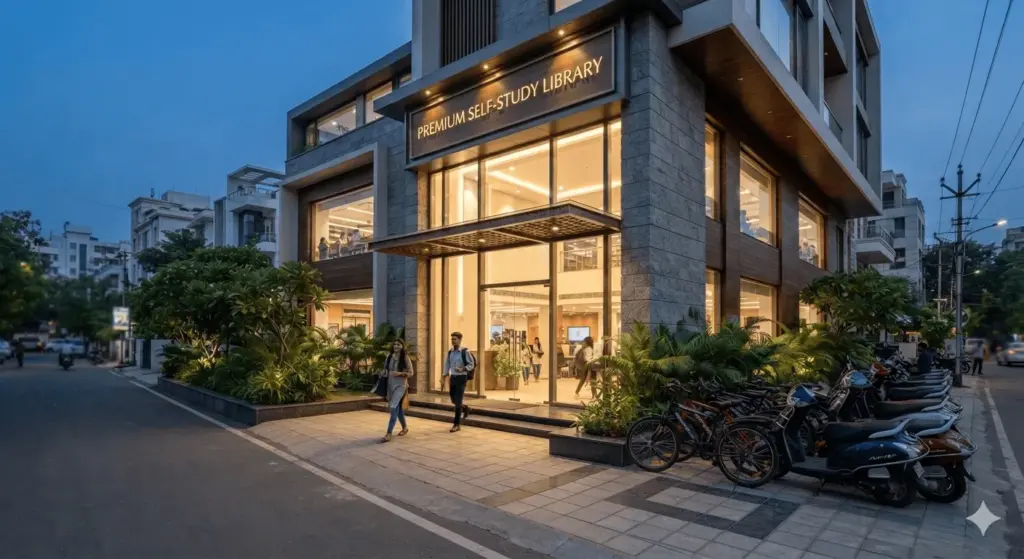
A professional exterior builds trust before students even enter the library.
Evaluate the Building
Once you’ve shortlisted a location, evaluate the building itself.
Ceiling Height
Higher ceilings improve ventilation and create a more spacious feeling.
Avoid buildings that feel cramped.
Natural Light
Natural daylight improves the study environment.
Large windows also reduce electricity usage during the day.
Ventilation
Even with air conditioning, proper airflow matters.
A poorly ventilated library quickly feels uncomfortable when occupancy increases.
Electrical Capacity
Modern students use:
- Laptops
- Tablets
- Mobile phones
Every seat should have convenient charging access.
Also ensure the building’s electrical system can handle:
- Air conditioners
- Lighting
- Computers
- CCTV
- Routers
Washrooms
Clean washrooms influence student satisfaction far more than many owners realize.
Check:
- Water supply
- Drainage
- Ventilation
- Ease of cleaning
Never compromise here.
Founder Insight
Students may never compliment you for having clean washrooms.
But they will definitely remember if they’re dirty.
Sometimes the smallest operational details have the biggest impact on renewals.
Space Planning
Don’t calculate your capacity by asking:
“How many chairs can fit?”
Instead ask:
“How many students can study comfortably?”
These are two very different questions.
Overcrowding increases:
- Noise
- Discomfort
- Complaints
- Student turnover
Comfort increases:
- Renewals
- Reviews
- Referrals
Comparison Table
| Overcrowded Library | Premium Library |
|---|---|
| Maximum seat density | Comfortable spacing |
| Difficult movement | Easy movement |
| More distractions | Better concentration |
| Higher complaints | Higher student satisfaction |
| Short-term thinking | Long-term retention |
Parking Matters
Many students travel by:
- Motorcycle
- Scooter
- Bicycle
- Car
If parking is difficult,
students may choose another library even if yours is better inside.
Always evaluate:
- Parking capacity
- Security
- Lighting
- Accessibility
Safety Should Never Be Ignored
Many students arrive:
- Early morning
- Late evening
Choose an area where students feel safe.
Well-lit surroundings and secure access improve confidence for both students and parents.
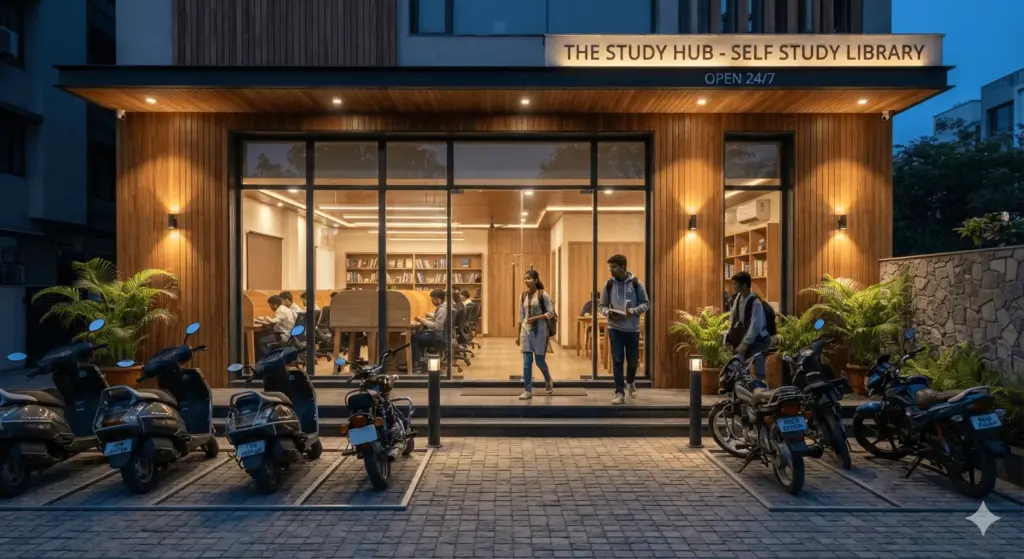
Easy access and visible branding improve first impressions.
Don’t Choose the Cheapest Rent
This is one of the most expensive mistakes new owners make.
Saving ₹10,000–₹20,000 in monthly rent means very little if your location reduces occupancy.
A better location often pays for itself through:
- Higher admissions
- Better retention
- Premium pricing
- Stronger referrals
Think of rent as an investment, not just an expense.
Founder Principle #4
Pay More for Demand, Not Less for Compromise
A premium location with strong student demand usually outperforms a cheaper location with weak demand.
Choose the place where students already are.
Property Evaluation Checklist
Before signing a lease, confirm the following:
Demand
- ✅ Student population nearby
- ✅ Coaching institutes within reach
- ✅ Hostels and PGs nearby
Accessibility
- ✅ Easy to find
- ✅ Good road access
- ✅ Public transport available
- ✅ Parking available
Building
- ✅ Adequate ceiling height
- ✅ Good ventilation
- ✅ Natural lighting
- ✅ Reliable electricity
- ✅ Clean washrooms
- ✅ Water supply
- ✅ Strong internet availability
Business Potential
- ✅ Affordable rent relative to demand
- ✅ Scope for future expansion
- ✅ Professional surroundings
- ✅ Positive first impression
Common Mistake
❌ Choosing a property first and researching demand later.
✔ Always validate demand before committing to a lease.
Internal Reading
Now that you’ve selected the right location, the next question is:
How much money should you invest—and where should you spend it?
👉 Read Next: Self-Study Library Investment & Budget Planning Guide (SWA-004)
Key Takeaways
- Location has a direct impact on occupancy and profitability.
- Prioritize demand, accessibility, and student convenience.
- Design for comfort, not maximum seating capacity.
- Never sacrifice quality for lower rent.
- A premium location often produces better long-term returns than a cheaper alternative.
Step 3: Investment Planning – How Much Does It Cost to Start a Self-Study Library in India?
One of the first questions every aspiring library owner asks is:
“How much investment is required to start a self-study library?”
The honest answer is:
It depends.
The total investment varies based on:
- Your city
- Property size
- Rental or owned premises
- Interior quality
- Number of seats
- Facilities offered
- Positioning (Budget, Premium, or Luxury)
Instead of asking:
“How much does it cost?”
Ask:
“How much should I invest to deliver the experience my target students expect?”
That shift in thinking changes everything.
Founder Principle #5
Don’t Build the Cheapest Library. Build the Smartest One.
Many first-time owners spend money where students don’t care and save money where students do.
For example:
❌ Expensive reception desk
❌ Decorative walls
❌ Fancy wallpaper
But they buy:
- Cheap chairs
- Small tables
- Poor lighting
- Weak internet
Students won’t renew because of an expensive reception.
They renew because studying feels comfortable every day.
Investment Categories
A professional self-study library typically requires investment in the following areas.
| Category | Priority |
|---|---|
| Security Deposit | High |
| Interior Work | High |
| Chairs | Very High |
| Study Tables | Very High |
| Electrical Work | High |
| Air Conditioning | High |
| Lighting | High |
| Internet & Networking | High |
| CCTV | Medium |
| Reception | Medium |
| Branding & Signage | Medium |
| Library Software | High |
| Miscellaneous | Medium |
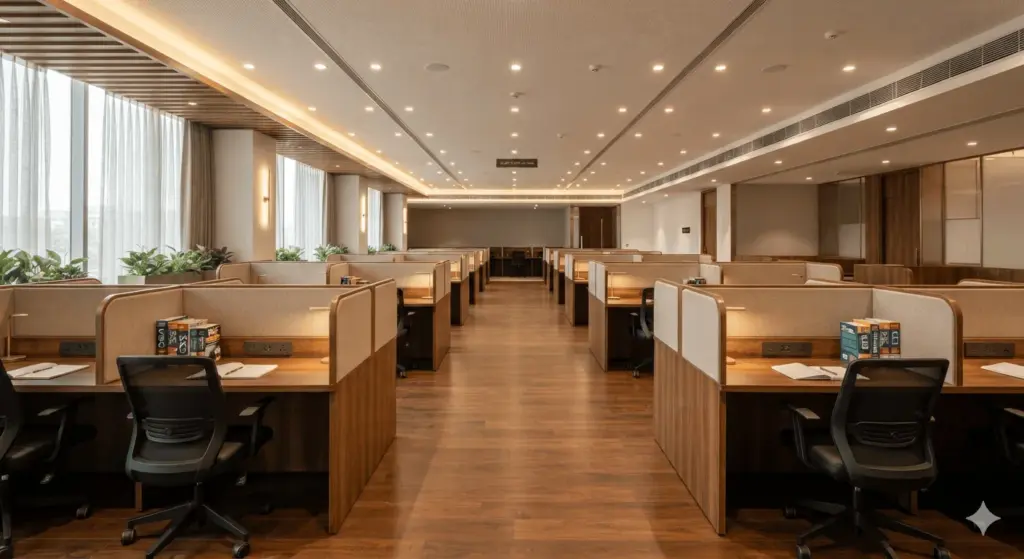
Invest in comfort, functionality, and durability rather than unnecessary decoration.
Where Should You Spend More?
Some investments directly improve the student experience.
These deserve your highest priority.
Comfortable Chairs
Students spend:
- 6 hours
- 8 hours
- Sometimes 12 hours
every day sitting.
A poor-quality chair creates:
- Back pain
- Fatigue
- Complaints
- Lower renewals
A premium chair creates:
- Better comfort
- Longer study sessions
- Higher satisfaction
Never compromise here.
Study Tables
Tables should provide enough space for:
- Books
- Laptop
- Notebook
- Water bottle
Small tables frustrate students.
Larger tables improve comfort significantly.
Air Conditioning
Students notice room temperature immediately.
Maintain a comfortable temperature throughout the year.
Also remember:
Good ventilation is just as important as air conditioning.
Lighting
Lighting should be:
- Bright
- Evenly distributed
- Comfortable for long reading sessions
Avoid:
- Dim rooms
- Harsh glare
- Flickering lights
Internet
Even students who primarily use books often require internet for:
- Online tests
- Research
- Downloading notes
- Video lectures
Reliable Wi-Fi is now an expected facility.
Founder Insight
Whenever I upgraded facilities, students noticed improvements in comfort much faster than decorative changes.
They appreciated:
- Better chairs
- Better lighting
- Cleaner washrooms
- Improved ventilation
Those investments generated stronger word-of-mouth than expensive interior decoration.
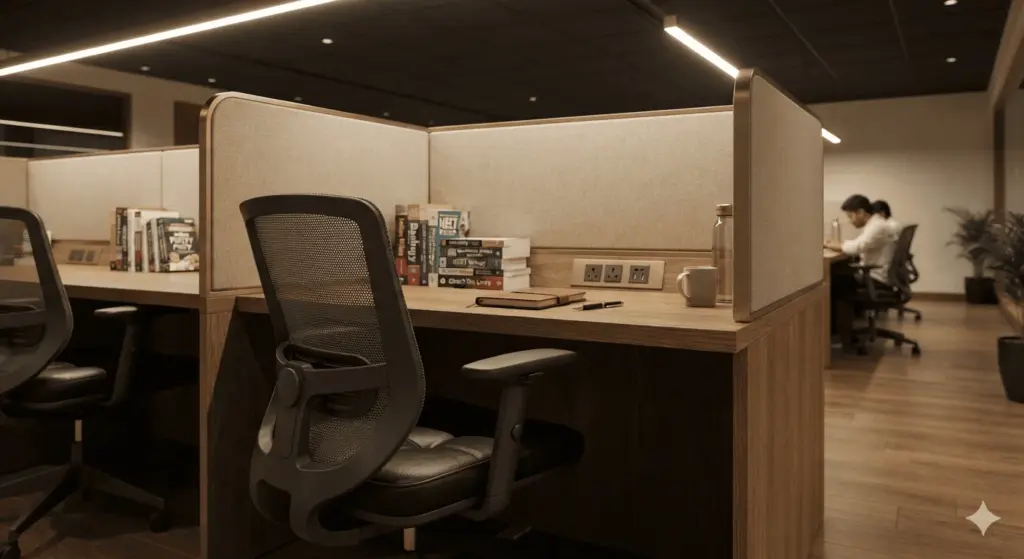
Comfortable seating is one of the highest-return investments in a self-study library.
Where Can You Save Money?
Being cost-conscious is different from being cheap.
You can reduce unnecessary expenses without affecting the student experience.
Examples include:
Reception
A clean, organized reception is sufficient.
It doesn’t need expensive marble or luxury furniture.
Decorative Elements
Avoid excessive spending on:
- Fancy wall panels
- Decorative ceilings
- Luxury décor
Students appreciate a clean environment more than expensive decoration.
Furniture That Doesn’t Affect Study
Invest where students spend their time.
Not where they spend five minutes.
Budget vs Premium vs Luxury
Think carefully about your positioning.
| Feature | Budget | Premium | Luxury |
|---|---|---|---|
| Chair Quality | Basic | Ergonomic | Premium Ergonomic |
| Table Size | Standard | Large | Executive |
| Seat Spacing | Moderate | Comfortable | Spacious |
| Interior Finish | Functional | Professional | High-End |
| Membership Fee | Lower | Mid-High | Premium |
Choose the category that matches your market research.
Don’t create a luxury library in an area that only supports budget pricing.
Likewise, don’t build a budget library in a market willing to pay for premium quality.
Don’t Forget Working Capital
Many owners spend every rupee on construction.
Then they have little money left for:
- Marketing
- Electricity
- Salaries
- Internet
- Maintenance
Always reserve funds to operate comfortably during your first few months.
Founder Principle #6
Cash Flow Is More Important Than Beautiful Interiors
Your library doesn’t become successful on opening day.
It becomes successful when it consistently attracts and retains students.
Protect your cash flow.
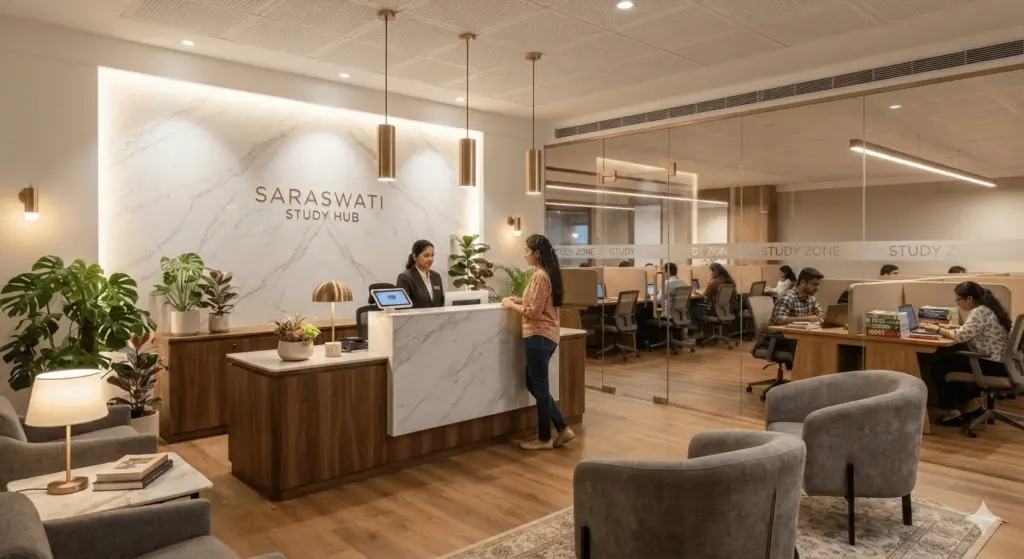
A simple, organized reception creates a strong first impression without excessive cost.
Investment Planning Checklist
Before starting construction:
Planning
- ✅ Estimate your total budget.
- ✅ Reserve working capital.
- ✅ Prioritize comfort-focused investments.
Furniture
- ✅ Select durable ergonomic chairs.
- ✅ Choose spacious study tables.
Infrastructure
- ✅ Plan electrical capacity.
- ✅ Install reliable internet.
- ✅ Design proper lighting.
- ✅ Ensure adequate ventilation.
Technology
- ✅ Install CCTV.
- ✅ Choose a library management system.
- ✅ Plan for future expansion.
Common Mistake
❌ Spending heavily on decorative interiors before investing in chairs and study tables.
✔ Students remember how comfortable they feel—not how expensive the reception looked.
Internal Reading
You’ve now planned your investment.
The next question is:
How should your library actually look?
A beautiful library isn’t necessarily an effective one.
The best libraries are designed around student comfort and productivity.
👉 Read Next: How to Design a Premium Self-Study Library Students Love (SWA-005)
Key Takeaways
- Invest in comfort before decoration.
- Prioritize chairs, tables, lighting, ventilation, and internet.
- Match your investment to your local market.
- Reserve enough working capital to operate confidently after opening.
- Every investment should improve the student’s study experience or operational efficiency.
Step 4: Design a Premium Self-Study Library Students Love
A student usually decides whether they like your library within the first five minutes of entering.
They immediately notice:
- Is it clean?
- Is it quiet?
- Are the chairs comfortable?
- Is the lighting good?
- Does it feel professional?
These first impressions influence whether they purchase a membership, recommend your library, and renew their subscription.
Many new owners believe premium design means expensive interiors.
It doesn’t.
Premium design means creating a study environment where students can remain focused for long hours without discomfort.
That’s what students remember.
Founder Principle #7
Design for Productivity, Not Decoration
Your library isn’t a café.
It isn’t a hotel.
It isn’t a showroom.
It’s a place where students prepare for some of the most important examinations of their lives.
Every design decision should answer one question:
“Will this help students study better?”
If the answer is no, don’t spend money on it.
First Impressions Matter
Imagine two libraries.
Library A
- Beautiful reception
- Expensive wallpaper
- Luxury decoration
But…
- Uncomfortable chairs
- Small tables
- Poor lighting
- Crowded seating
Library B
Simple reception.
Minimal decoration.
But…
- Comfortable ergonomic chairs
- Spacious tables
- Bright lighting
- Excellent ventilation
- Clean washrooms
- Quiet atmosphere
Which library will students renew?
Almost always…
Library B.
Students spend 99% of their time in the study hall—not at the reception.
Students stay longer in libraries designed for comfort rather than maximum seating capacity.
Plan the Layout Before Buying Furniture
One of the biggest mistakes owners make is buying furniture before planning the layout.
Instead, follow this sequence:
- Measure the room.
- Plan walking space.
- Decide emergency exits.
- Mark electrical points.
- Plan lighting.
- Finalize seating layout.
- Purchase furniture.
A thoughtful layout improves both comfort and operational efficiency.
Seat Spacing Is More Important Than Seat Count
Many owners ask:
“How many seats can fit?”
A better question is:
“How many students can study comfortably?”
Trying to maximize seat count often leads to:
- Less privacy
- More distractions
- Increased noise
- Poor movement
- Student dissatisfaction
Students preparing for competitive exams may spend 8–12 hours every day at your library.
They value personal space.
Give it to them.
Founder Insight
One lesson I learned is that reducing the number of seats slightly can actually increase profitability.
Why?
Because students stay longer.
They renew more often.
They recommend the library to friends.
High retention is usually more valuable than squeezing in a few extra seats.
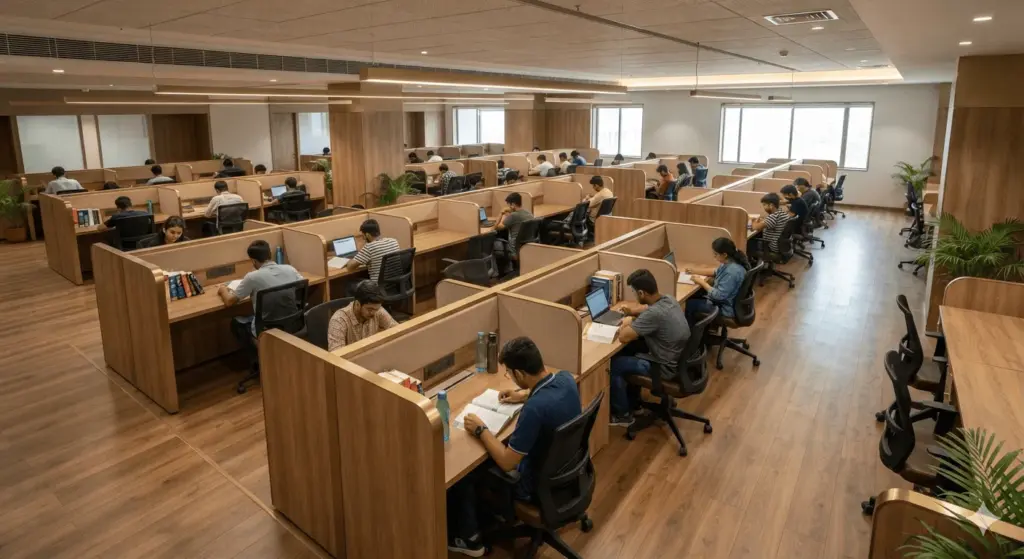
Comfortable spacing improves concentration and reduces distractions.
Choosing the Right Chair
If you invest in only one premium item…
Make it the chair.
Students spend hundreds of hours sitting.
Poor chairs create:
- Back pain
- Neck strain
- Fatigue
- Complaints
- Lower renewal rates
Good ergonomic chairs improve:
- Comfort
- Posture
- Focus
- Student satisfaction
Choose durable commercial-grade chairs that are easy to clean and built for daily use.
Selecting Study Tables
The ideal study table should comfortably accommodate:
- Books
- Notebook
- Laptop
- Water bottle
- Stationery
Students dislike cramped workspaces.
A slightly larger table creates a much better study experience.
Rounded corners and durable finishes also improve safety and longevity.
A spacious desk allows students to study comfortably for long hours.
Lighting Design
Lighting directly affects concentration.
Poor lighting causes:
- Eye strain
- Fatigue
- Reduced productivity
Aim for lighting that is:
- Bright
- Evenly distributed
- Comfortable for reading
- Free from glare
Where possible, combine natural daylight with high-quality LED lighting.
Avoid dark corners and inconsistent illumination.
Ventilation & Air Conditioning
Temperature has a major impact on comfort.
Even the best interiors won’t compensate for a hot, stuffy room.
Plan for:
- Proper airflow
- Well-maintained air conditioners
- Fresh air circulation where possible
A comfortable environment encourages students to stay longer.
Noise Control
Silence is one of the most valuable features of a self-study library.
Control noise by:
- Using soft door closers
- Adding rubber pads under chair legs
- Keeping reception conversations quiet
- Separating discussion areas from study halls
- Displaying clear silence guidelines
Remember:
Students don’t pay just for a seat.
They pay for uninterrupted concentration.
Founder Principle #8
Silence Is a Premium Feature
Students preparing for important examinations often choose a library simply because it is quieter than the alternatives.
Protect that advantage.
Washrooms
A clean washroom builds trust.
A dirty washroom damages your reputation immediately.
Create a daily cleaning schedule.
Check:
- Floors
- Toilets
- Hand wash
- Water supply
- Ventilation
- Dustbins
Students may never compliment clean washrooms.
But they’ll definitely notice poor ones.
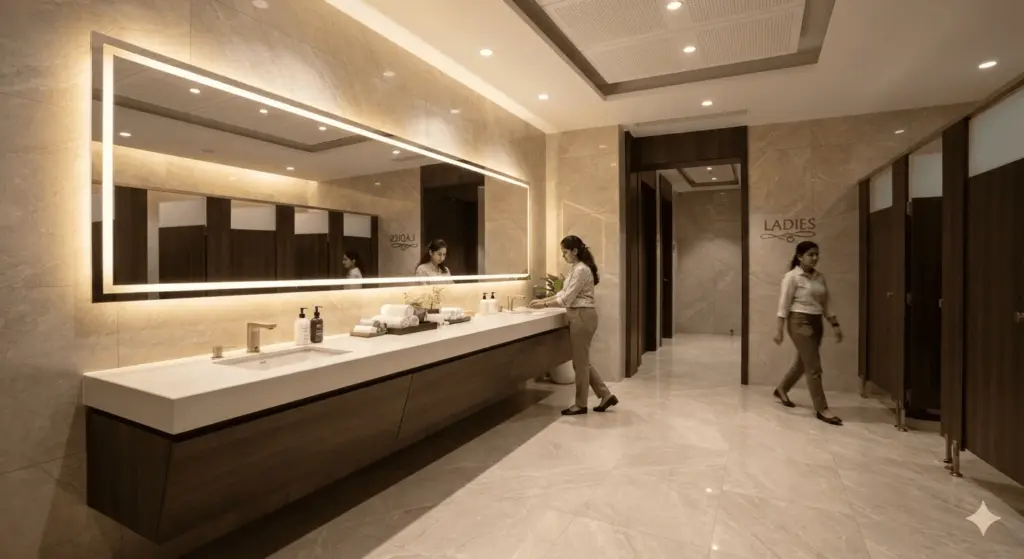
Clean facilities demonstrate professionalism and improve student confidence.
Reception Design
The reception is your first opportunity to build confidence.
Keep it:
- Clean
- Organized
- Welcoming
- Professional
Include:
- Membership information
- Library rules
- Contact details
- Brochures
- Seating plan
You don’t need expensive furniture.
You need a professional appearance.
Branding Inside the Library
Your branding should feel subtle and professional.
Examples include:
- Logo near reception
- Direction signs
- Library rules
- Motivational quotes (used sparingly)
- Emergency information
Avoid covering every wall with posters.
Too much visual clutter can become distracting.
Comparison Table
| Poor Design | Professional Design |
|---|---|
| Maximum seats | Comfortable spacing |
| Cheap chairs | Ergonomic seating |
| Dim lighting | Bright LED lighting |
| Weak ventilation | Fresh, comfortable airflow |
| No charging points | Charging at every seat |
| Decorative focus | Productivity focus |
| Inconsistent cleanliness | Daily maintenance |
Common Mistake
❌ Designing the library based on appearance alone.
✔ Design it around how students actually study.
Comfort and functionality always outperform unnecessary decoration.
Action Checklist
Before opening your library, confirm:
Furniture
- ✅ Ergonomic chairs selected
- ✅ Spacious study tables installed
- ✅ Comfortable seat spacing maintained
Infrastructure
- ✅ Bright LED lighting
- ✅ Reliable air conditioning
- ✅ Good ventilation
- ✅ Charging points at every seat
- ✅ Stable Wi-Fi
Facilities
- ✅ Clean washrooms
- ✅ Drinking water
- ✅ CCTV
- ✅ Reception ready
- ✅ Professional signage
Internal Reading
A beautifully designed library deserves a pricing strategy that reflects its value.
In the next section, you’ll learn:
- How to price memberships confidently
- Why competing on price is a mistake
- Premium pricing strategies
- Membership plans
- Understanding student paying capacity
👉 Read Next: How to Price Your Self-Study Library for Maximum Profit (SWA-006)
Key Takeaways
- Design for productivity—not decoration.
- Invest first in chairs, tables, lighting, and ventilation.
- Spacious layouts improve student satisfaction and renewals.
- Cleanliness and silence are competitive advantages.
- A premium experience allows you to charge premium prices.
Step 5: Pricing Your Self-Study Library for Maximum Profit
One of the biggest fears new library owners have is:
“If I charge more than my competitors, will students join?”
It’s a valid concern—but it’s also one of the biggest reasons many libraries struggle to become profitable.
Pricing is not about being the cheapest.
Pricing is about communicating value.
Students compare what they receive, not just what they pay.
A library that charges ₹800 per month and provides an exceptional experience often attracts more loyal students than a library charging ₹500 with poor facilities.
The goal isn’t to win a price war.
The goal is to build a business that students happily pay for because they believe it’s worth it.
Founder Principle #9
Never Compete on Price Alone
When you lower prices to beat competitors, two things usually happen:
- Your profit margins shrink.
- Your competitors lower their prices too.
Nobody wins.
Instead, improve the experience so that students compare your value—not your price.
Premium businesses don’t apologize for charging more.
They justify it.
What Students Actually Pay For
Students rarely choose a library because it’s ₹100 cheaper.
They choose it because they believe they’ll study better there.
The value of your library comes from the complete experience:
- Comfortable seating
- Quiet environment
- Spacious layout
- Clean washrooms
- Reliable Wi-Fi
- Air conditioning
- Helpful management
- Consistent cleanliness
- Safe atmosphere
- Professional operations
Every improvement makes your pricing easier to justify.
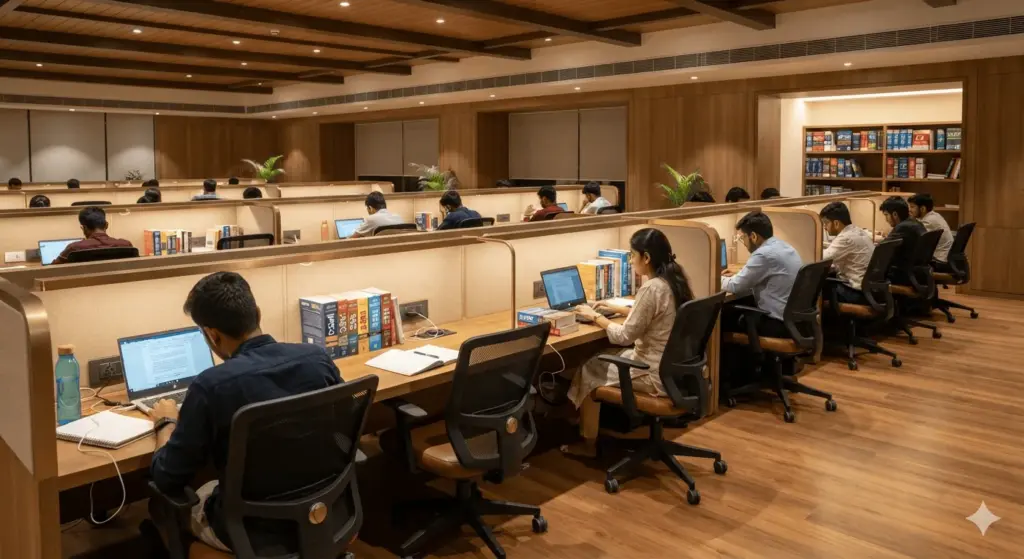
Students pay for a better study experience—not simply for access to a chair.
Research Before Setting Prices
Never copy a competitor’s pricing without understanding why they charge that amount.
Visit nearby libraries and record:
| Library | Monthly Fee | Facilities | Occupancy |
|---|---|---|---|
| Library A | ₹700 | Basic | High |
| Library B | ₹1100 | Premium Chairs, AC | Medium |
| Library C | ₹1500 | Premium Experience | High |
Now ask yourself:
- Which library would you personally choose?
- Why?
- What would justify paying more?
These answers reveal how your market perceives value.
Understanding Student Psychology
Students preparing for UPSC, SSC, Banking, CA, NEET PG, or GATE often spend 200–300 hours every month in the library.
Viewed that way, even a ₹200 difference in membership becomes relatively small if the environment significantly improves their productivity.
For many students, passing an exam is worth far more than saving a small amount on monthly fees.
Position your library as an investment in their success—not as the cheapest option available.
Founder Story
When I opened my library, nearby competitors charged between ₹400 and ₹600 per month.
Several people advised me to open at ₹500 or even lower.
Instead, I focused on creating a noticeably better environment.
I opened at ₹600.
As students experienced the quality, renewals increased.
Over time, I confidently increased the fee to ₹700, and later to ₹800.
Very few students objected.
Why?
Because the value had increased alongside the price.
That experience taught me an important lesson:
Students accept higher prices when they clearly experience higher value.
Different Pricing Models
Every market is different, but most successful libraries use one or more of these models.
Monthly Membership
The most common option.
Ideal for:
- Competitive exam students
- University students
- Long-term members
Provides predictable recurring revenue.
Quarterly Membership
Offer a small discount for students who commit for three months.
Benefits:
- Better cash flow
- Higher retention
- Lower administrative work
Half-Yearly Membership
Suitable for students preparing for longer examination cycles.
Reward commitment with additional value rather than large discounts.
Annual Membership
Useful for serious aspirants who expect to study throughout the year.
Rather than reducing the monthly fee dramatically, consider offering benefits such as:
- Reserved seating
- Locker access
- Priority renewals
Premium Seating
If your space allows, create different seating categories.
Example:
| Plan | Features |
|---|---|
| Standard | Comfortable seating, Wi-Fi, Charging |
| Premium | Larger desk, Quieter zone, Preferred seating |
This allows students to choose according to their budget while increasing your average revenue.
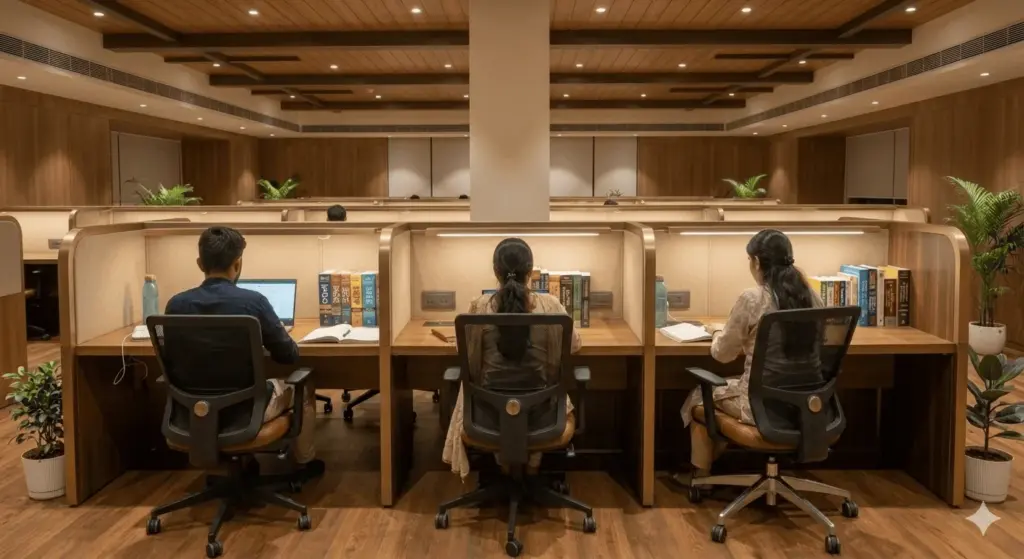
Tiered seating options increase flexibility for students and improve revenue potential.
Should You Offer Discounts?
Yes—but carefully.
Avoid constant discounting.
Instead, use promotions strategically.
Examples include:
- Opening week offer
- Referral rewards
- Group admissions
- Long-term membership bonuses
Your regular price should always reflect the true value of your service.
Frequent discounts can reduce the perceived quality of your library.
Avoid Price Wars
Imagine two nearby libraries.
One lowers prices by ₹100.
The other responds by lowering another ₹100.
Soon both businesses earn less while operating costs remain the same.
Instead of joining this race, improve your experience.
Students remember quality long after they’ve forgotten a small price difference.
Founder Insight
One satisfied student who recommends your library to five friends is worth much more than ten students who joined only because you were the cheapest.
Build loyalty.
Not discounts.
Display Pricing Professionally
Be transparent.
Students appreciate clear pricing.
Display:
- Membership plans
- Included facilities
- Payment methods
- Library rules
- Renewal policy
Avoid hidden charges or confusing fee structures.
Professional communication builds trust.
Pricing Checklist
Before finalizing your pricing strategy:
Market Research
- ✅ Compare nearby libraries.
- ✅ Understand local paying capacity.
- ✅ Identify your competitive advantage.
Positioning
- ✅ Budget
- ✅ Premium
- ✅ Luxury
Choose one—and be consistent.
Membership Plans
- ✅ Monthly
- ✅ Quarterly
- ✅ Half-Yearly
- ✅ Annual
Communication
- ✅ Transparent pricing
- ✅ Clear policies
- ✅ No hidden fees
Common Mistake
❌ Setting prices based only on competitors.
✔ Set prices based on the value your library delivers.
Internal Reading
A great library with the right pricing still needs students.
The next section covers one of the biggest challenges every new owner faces:
How do you get your first 100 members?
You’ll learn practical marketing strategies, referral systems, local SEO, Google Business optimization, and offline promotion methods that actually work.
👉 Read Next: How to Get Your First 100 Students for Your Self-Study Library (SWA-007)
Key Takeaways
- Compete on value—not price.
- Students willingly pay more for a better experience.
- Use tiered membership plans to increase revenue.
- Offer discounts strategically, not continuously.
- Transparent pricing builds trust and supports long-term profitability.
- Premium pricing becomes sustainable when supported by premium service.
Step 6: How to Get Your First 100 Students and Build a Strong Local Brand
Opening your library is only the beginning.
The real challenge starts the day you unlock the doors and wait for your first student.
Many library owners believe that once the interiors are complete, students will automatically come.
Unfortunately, that’s rarely how it works.
Even the best library needs visibility, trust, and consistent marketing.
The good news?
You don’t need a massive advertising budget.
If you build credibility, optimize your online presence, and create a great student experience, your first 100 students are completely achievable.
Founder Principle #10
Students Trust Students More Than Advertisements
The most powerful marketing channel for a self-study library isn’t Facebook Ads or flyers.
It’s a happy student recommending your library to a friend.
Your goal is to create an experience that people naturally talk about.
Every satisfied student becomes part of your marketing team.
Start Marketing Before You Open
Don’t wait until your opening day to start promoting your library.
Begin 2–4 weeks before launch.
Share updates such as:
- Interior progress
- Furniture installation
- AC setup
- Lighting
- Branding
- Reception area
- Opening announcement
This creates curiosity and anticipation in your local community.
Sharing your progress before launch builds anticipation and awareness.
Optimize Your Google Business Profile
For most libraries, Google Business Profile is the single most important marketing asset.
When students search:
- Self Study Library Near Me
- Reading Library Near Me
- Library Near Me
your Google listing should appear prominently.
A complete profile should include:
- Business name
- Accurate address
- Phone number
- Operating hours
- Website
- High-quality photos
- Categories
- Facilities
- Regular updates
Add High-Quality Photos
Upload professional images of:
- Exterior
- Reception
- Study hall
- Individual desks
- Premium seating
- Washrooms
- Drinking water area
- Parking
- Signboard
Students often decide whether to visit based on photos alone.
Poor images reduce trust.
Encourage Google Reviews
Every satisfied student should be encouraged to leave an honest review.
Don’t wait until months later.
Ask while their experience is fresh.
Reviews improve:
- Trust
- Local SEO
- Click-through rate
- Student confidence
A library with 100 genuine positive reviews has a significant advantage over one with only a handful.
Founder Insight
One detailed five-star review explaining how your library helped someone stay focused is often more persuasive than any advertisement you can buy.
People trust real experiences.
Invest in earning them.
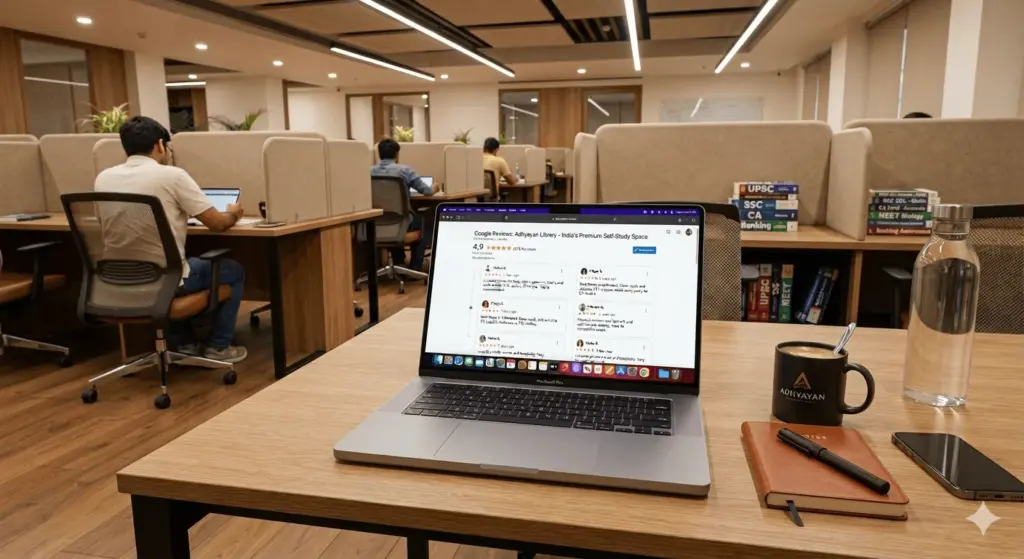
Genuine student reviews build credibility and improve local search visibility.
Build an Instagram Presence
Students spend a lot of time on Instagram.
Your account doesn’t need to be viral.
It needs to be professional and active.
Post consistently:
- Study hall photos
- Student testimonials
- Library updates
- Study tips
- Motivational content
- Festival greetings
- Behind-the-scenes videos
Aim for authenticity rather than perfection.
Create Short Videos
Short-form videos perform exceptionally well.
Ideas include:
- Library walkthrough
- Day in the library
- Before-and-after interior transformation
- Student success stories
- Quiet study atmosphere
- Time-lapse study sessions (with permission)
These videos help potential students visualize the experience before visiting.
WhatsApp Marketing
WhatsApp remains one of the simplest and most effective local marketing tools.
Use it to:
- Share opening announcements
- Notify students of available seats
- Promote special offers
- Send renewal reminders
- Answer inquiries quickly
Avoid sending excessive promotional messages.
Focus on providing useful information.
Referral Program
Happy students naturally recommend good libraries.
Reward that behavior.
Example:
Refer a friend who joins and receive one week of free membership or another meaningful benefit.
Referral programs often produce highly qualified new members because they come through trusted recommendations.
Founder Principle #11
Every Happy Student Should Bring Another Student
Instead of asking:
“How can I find more students?”
Ask:
“How can I create an experience that students can’t stop recommending?”
The second question produces much better long-term results.
Local Partnerships
Consider building relationships with:
- Coaching institutes
- Bookstores
- Stationery shops
- Hostels
- PG accommodations
- Cafés frequented by students
Leave brochures or negotiate referral partnerships where appropriate.
These businesses already serve your target audience.
Offline Marketing Still Works
Digital marketing is important, but don’t ignore offline opportunities.
Examples include:
- Banners
- Direction signs
- Pamphlets near coaching centers
- Posters on notice boards (where permitted)
- Local newspaper coverage
- Community events
Your objective is simply to make students aware that your library exists.
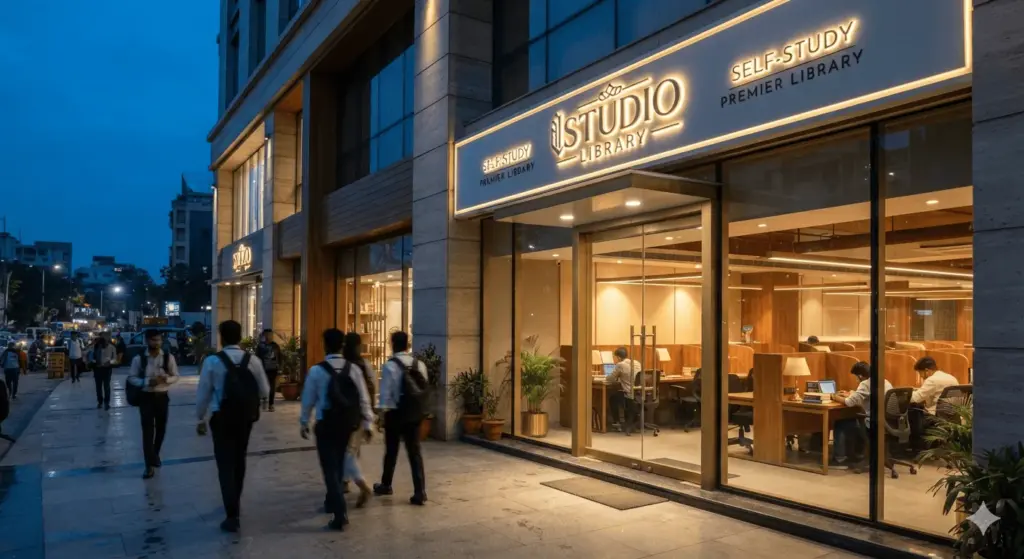
Clear signage improves walk-in inquiries and local visibility.
Offer a Library Tour
Many students hesitate because they don’t know what to expect.
Invite them to visit.
Walk them through:
- Reception
- Study hall
- Facilities
- Membership plans
- Library rules
Never pressure them to join.
A professional tour builds confidence.
Respond Quickly to Inquiries
Whether someone contacts you through:
- Phone
respond quickly.
Fast responses create a professional impression.
Slow responses often result in students choosing another library.
Launch Week Strategy
Your first week matters.
Create excitement.
Ideas include:
- Opening ceremony
- Free library tour
- Introductory membership offers
- Welcome kits
- Social media coverage
- Student photographs (with permission)
A successful launch generates momentum that continues through word-of-mouth.
Founder Principle #12
Marketing Doesn’t End After Opening Day
Many owners stop promoting their library after the first month.
Successful libraries market continuously.
Every month should include:
- New photos
- New Google Reviews
- Social media updates
- Student testimonials
- Community engagement
Marketing is an ongoing process—not a one-time event.
First 100 Students Checklist
Before Opening
- ✅ Google Business Profile created
- ✅ Professional photographs uploaded
- ✅ Instagram page active
- ✅ WhatsApp Business account ready
- ✅ Branding installed
During Launch
- ✅ Invite local students
- ✅ Encourage Google Reviews
- ✅ Share videos on social media
- ✅ Offer library tours
- ✅ Collect student feedback
After Launch
- ✅ Post weekly updates
- ✅ Ask for referrals
- ✅ Monitor online reviews
- ✅ Improve facilities continuously
Common Mistake
❌ Spending heavily on advertisements while ignoring the student experience.
✔ Great libraries grow because satisfied students become enthusiastic promoters.
Internal Reading
Getting students is only half the journey.
Keeping them is where long-term profitability is built.
In the next section, you’ll learn how to:
- Manage daily operations
- Increase renewals
- Handle complaints professionally
- Build efficient systems
- Use technology to save time and improve the student experience
👉 Read Next: How to Run a Self-Study Library Efficiently (SWA-008)
Key Takeaways
- Start marketing before your opening day.
- Optimize your Google Business Profile and keep it updated.
- Collect genuine Google Reviews consistently.
- Use Instagram and short videos to showcase your library.
- Build a referral system that encourages students to recommend your library.
- Market continuously—even after your library is full.
Step 7: Running Your Self-Study Library Like a Professional Business
Getting students through your doors is a major achievement.
Keeping them month after month is what builds a profitable business.
Many library owners spend months planning their launch but very little time planning their daily operations. As a result, they find themselves overwhelmed by membership renewals, payment tracking, seat management, maintenance issues, and student complaints.
The most successful libraries don’t rely on memory or constant supervision.
They rely on systems.
A well-managed library feels organized, predictable, and professional. Students notice the difference, even if they can’t always explain it.
Founder Principle #13
Build Systems, Not Stress
Imagine two library owners.
The first owner spends every day answering the same questions:
- “Which seats are available?”
- “Has this student renewed?”
- “Who made today’s payment?”
- “Who forgot their ID card?”
The second owner has clear systems and software that handle these routine tasks.
Both owners have the same number of students.
One spends time solving problems.
The other spends time growing the business.
Your goal should always be the second approach.
Start Every Day with a Checklist
Professional businesses don’t depend on memory.
They depend on routines.
Before students arrive each day, confirm that everything is ready.
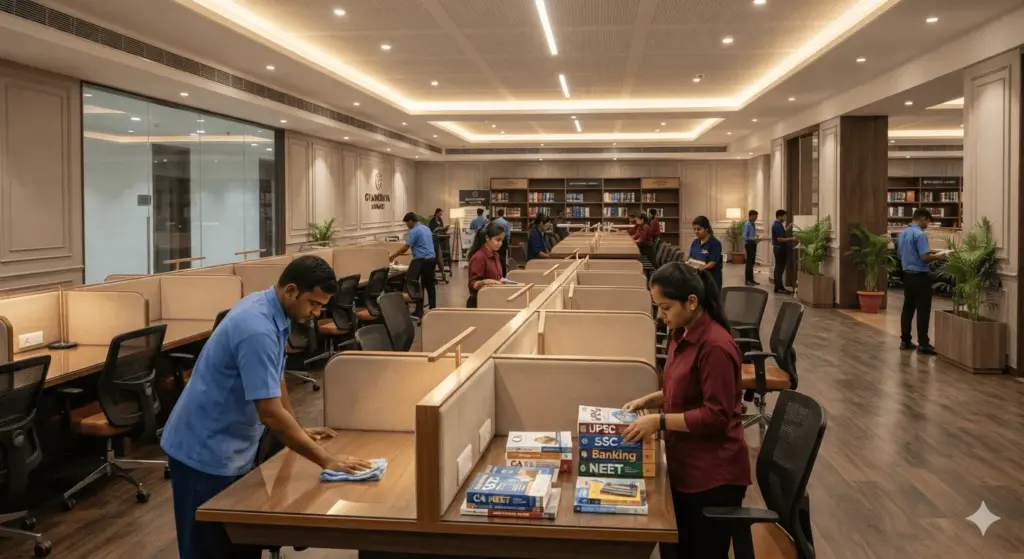
Daily Opening Checklist
- ✅ Turn on lights
- ✅ Switch on air conditioners
- ✅ Check internet connection
- ✅ Inspect CCTV system
- ✅ Clean study tables
- ✅ Arrange chairs properly
- ✅ Fill drinking water
- ✅ Clean washrooms
- ✅ Check reception area
- ✅ Ensure charging points are working
These tasks take only a few minutes but have a significant impact on the student experience.
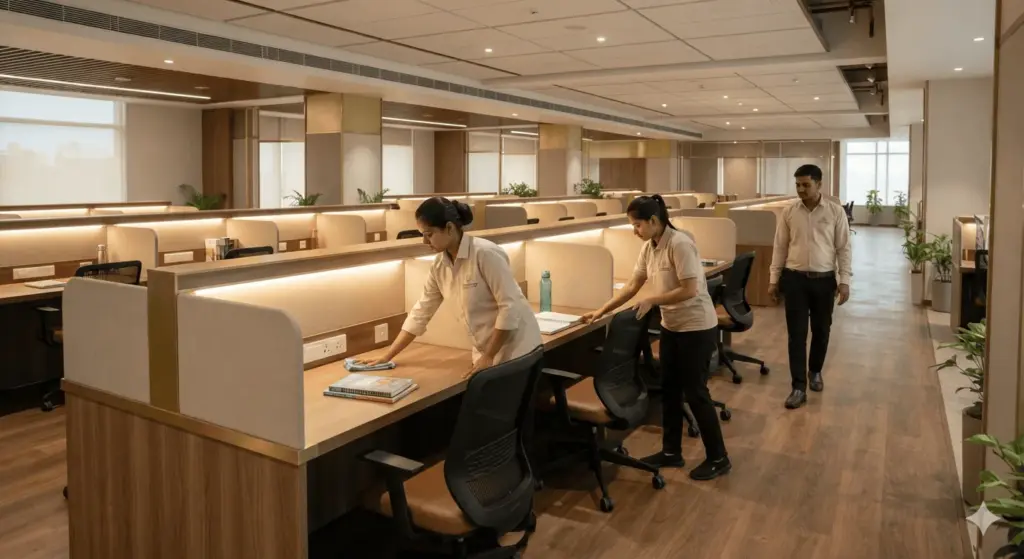
Consistent daily routines help maintain a professional study environment.
Maintain Cleanliness Every Day
Students may not compliment a clean library.
But they immediately notice when it’s dirty.
Daily cleaning should include:
- Study tables
- Chairs
- Floors
- Reception
- Washrooms
- Drinking water area
- Windows
- Dustbins
Cleanliness directly affects online reviews and membership renewals.
Founder Insight
Students often associate cleanliness with professionalism.
A clean library tells students:
“This business cares about quality.”
That impression builds trust.
Handle Student Complaints Professionally
No matter how well your library is managed, complaints will happen.
Examples include:
- Internet problems
- Noise
- Air conditioning
- Lighting
- Seating disputes
- Washroom maintenance
The goal isn’t to eliminate every complaint.
The goal is to respond quickly and respectfully.
When a student raises an issue:
- Listen carefully.
- Thank them for the feedback.
- Explain the solution.
- Resolve the problem promptly.
- Follow up if necessary.
Students are often more impressed by how you solve problems than by never having problems at all.
Never Ignore Small Issues
A loose chair.
A flickering light.
A broken charging point.
Each seems minor.
Together, they create a poor experience.
Inspect your library regularly and fix small problems before students begin complaining.
Preventive maintenance is always cheaper than repairing your reputation.
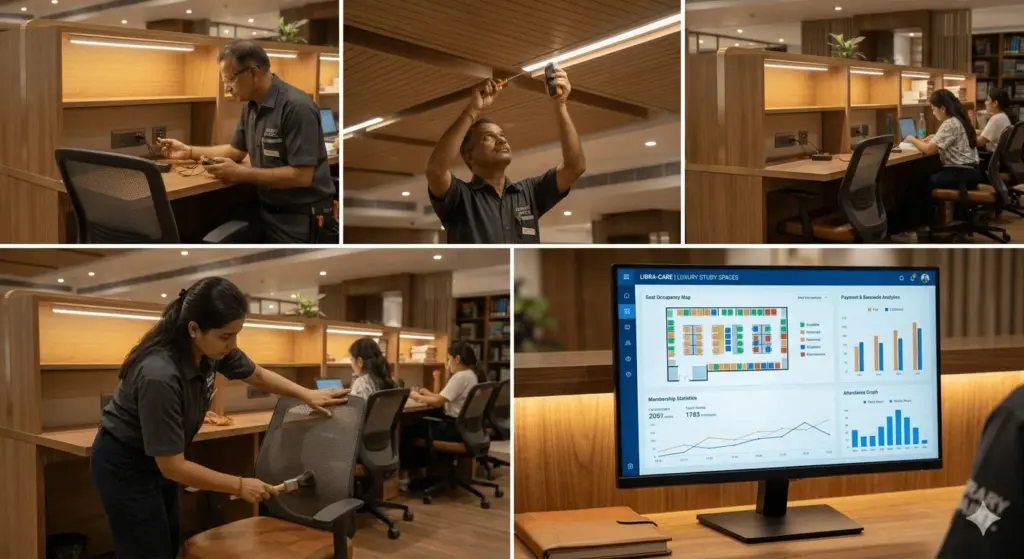
Regular maintenance prevents small issues from becoming major complaints.
Membership Renewals
Renewals are one of the most important indicators of library success.
A student who renews is telling you:
“This library is helping me.”
Rather than waiting for memberships to expire, contact students a few days beforehand.
Friendly reminders through WhatsApp or SMS help reduce accidental lapses.
Keep the renewal process quick and convenient.
Track Important Metrics
Successful library owners make decisions using data rather than assumptions.
Monitor key performance indicators (KPIs) such as:
| KPI | Why It Matters |
|---|---|
| Total Seats | Capacity planning |
| Occupied Seats | Occupancy rate |
| Monthly Renewals | Student satisfaction |
| New Admissions | Growth |
| Monthly Revenue | Financial performance |
| Pending Payments | Cash flow |
| Google Reviews | Reputation |
| Referral Admissions | Word-of-mouth success |
Review these numbers regularly.
They help you identify trends before problems become serious.
Founder Principle #14
What Gets Measured Gets Improved
If you don’t track occupancy, renewals, and revenue, you’ll struggle to understand what’s working.
Even a simple weekly review can reveal opportunities to improve.
Create Standard Operating Procedures (SOPs)
As your library grows, you’ll eventually hire staff or open additional branches.
Without documented processes, service quality becomes inconsistent.
Create simple SOPs for tasks such as:
- Opening procedures
- Closing procedures
- Student registration
- Membership renewal
- Complaint handling
- Cleaning schedules
- Emergency response
Written procedures ensure every student receives the same professional experience.
Technology Makes Operations Easier
Many new owners begin with notebooks and spreadsheets.
While this may work initially, it becomes difficult as membership grows.
A modern library management system can simplify tasks such as:
- Seat allocation
- Membership management
- Payment tracking
- Attendance
- Renewal reminders
- Reporting
- Student records
Technology reduces manual work, minimizes mistakes, and saves valuable time.
Founder Story
When we started managing our own library, many daily tasks were repetitive and time-consuming.
Tracking memberships, payments, seat availability, and renewals manually became increasingly difficult as the number of students grew.
That challenge eventually inspired the development of SeatWise—a platform designed specifically for self-study libraries.
Instead of relying on registers and spreadsheets, owners can manage their operations through a single dashboard, helping them save time and focus on improving the student experience.
The lesson wasn’t that every library needs complicated software.
It was that systems become increasingly valuable as your business grows.
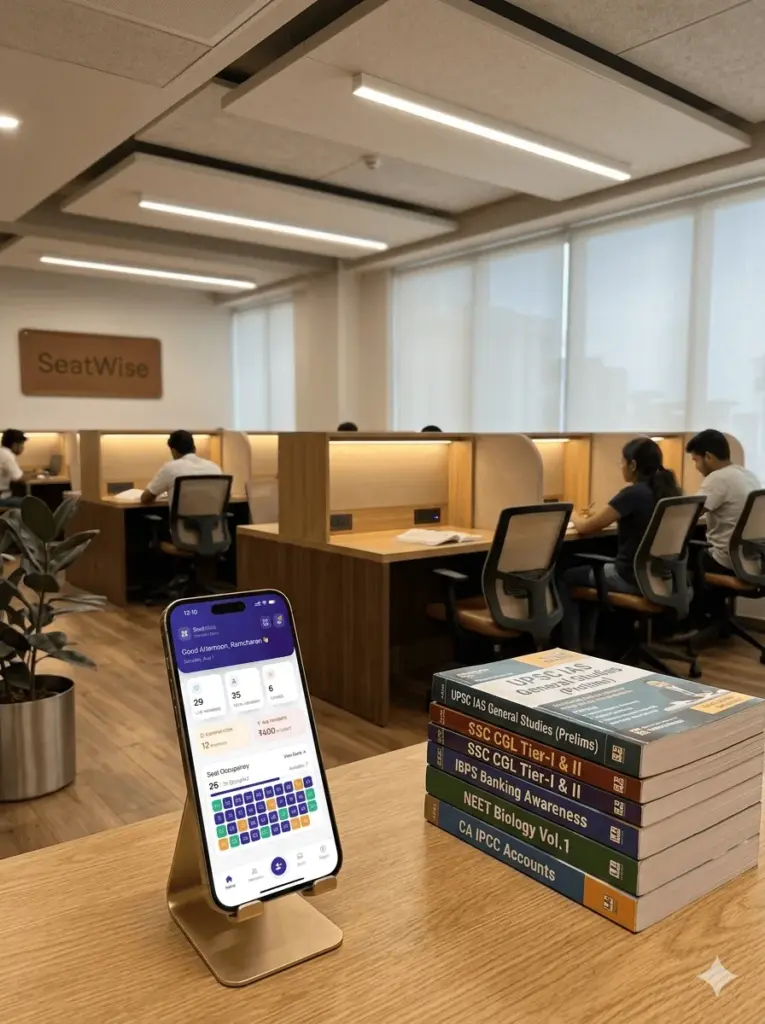
Library management software helps automate routine operations and improves efficiency.
Closing Routine
The end of the day is just as important as the beginning.
Daily Closing Checklist
- ✅ Verify student exits
- ✅ Switch off unnecessary lights
- ✅ Turn off air conditioners
- ✅ Lock windows and doors
- ✅ Secure cash (if applicable)
- ✅ Check CCTV recording
- ✅ Clean common areas
- ✅ Prepare for the next day
A consistent closing routine protects your assets and ensures the library is ready for the following morning.
Common Operational Mistakes
Avoid these common issues:
❌ Forgetting renewal reminders
❌ Ignoring maintenance requests
❌ Delaying complaint resolution
❌ Poor cleanliness
❌ Manual payment errors
❌ Inconsistent operating hours
❌ Lack of communication with students
Professional operations are built on consistency—not perfection.
Operations Checklist
Daily
- ✅ Clean study hall
- ✅ Check internet
- ✅ Inspect facilities
- ✅ Monitor occupancy
- ✅ Respond to inquiries
Weekly
- ✅ Review maintenance needs
- ✅ Analyze admissions
- ✅ Review Google Reviews
- ✅ Check financial records
Monthly
- ✅ Calculate occupancy rate
- ✅ Review renewal percentage
- ✅ Analyze marketing performance
- ✅ Plan improvements
Internal Reading
Running one successful library is an achievement.
Building multiple successful libraries requires a completely different mindset.
In the next section, you’ll learn:
- When to open a second branch
- How to scale without losing quality
- Building a recognizable brand
- Creating systems that support long-term growth
👉 Read Next: How to Scale Your Self-Study Library Business (SWA-009)
Key Takeaways
- Successful libraries run on systems, not memory.
- Daily checklists ensure consistent service quality.
- Respond quickly to student feedback and complaints.
- Track occupancy, renewals, revenue, and referrals regularly.
- Technology simplifies operations and supports growth.
- Strong operations create satisfied students—and satisfied students create sustainable businesses.
Step 8: Scaling Your Self-Study Library Business and Building a Recognizable Brand
Opening one successful self-study library is an achievement.
Building a brand that students recognize and trust across multiple locations is a completely different challenge.
Many owners make the mistake of opening a second branch too quickly.
The first library is profitable.
Seats are filling up.
Students are happy.
So they assume it’s time to expand.
But if your first library still depends entirely on your daily presence, you’re not ready to scale.
A second branch doesn’t solve operational problems—it multiplies them.
Scale only when your systems are strong enough to deliver the same student experience without your constant supervision.
Founder Principle #15
Scale Systems Before You Scale Locations
Don’t ask:
“Can I afford another branch?”
Ask:
“Can my business operate successfully without me being present every day?”
If the answer is no, improve your systems first.
Expansion should be built on consistency, not confidence alone.
When Are You Ready to Open a Second Branch?
There isn’t a fixed timeline.
Instead, look for clear indicators.
You may be ready when:
- Your occupancy remains above 85–90% for several months.
- Students regularly ask for another branch closer to them.
- Your operations run smoothly with documented SOPs.
- Staff can manage daily work independently.
- Your finances remain healthy after accounting for all expenses.
- You have enough working capital to invest without affecting your existing library.
If most of these conditions are not yet true, focus on strengthening your first location.
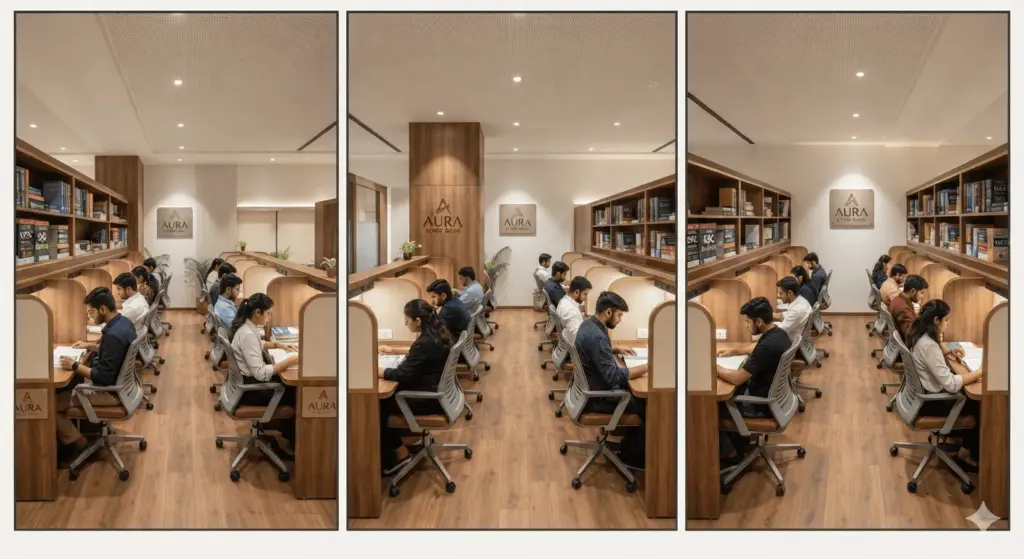
Caption: Expansion should maintain the same quality and student experience across every location.
Standardize Everything
Students should receive the same experience whether they visit Branch A or Branch B.
Create standards for:
- Chair models
- Study tables
- Lighting
- Color scheme
- Library rules
- Membership process
- Cleaning schedules
- Customer service
- Signage
- Pricing policy (where appropriate)
Consistency builds trust.
Trust builds brands.
Build a Brand, Not Just a Library
Think beyond your physical space.
Ask yourself:
What should students immediately associate with my library?
For example:
- Comfortable seating
- Quiet environment
- Professional management
- Clean facilities
- Reliable service
- Technology-driven operations
Every interaction should reinforce these qualities.
A strong brand reduces marketing costs because students already know what to expect.
Founder Insight
People don’t recommend businesses because of their logo.
They recommend businesses because of how those businesses make them feel.
If every student leaves your library thinking,
“This is the best place I’ve studied,”
your brand will grow naturally.
Use Technology to Scale
Managing one branch manually is possible.
Managing multiple branches manually becomes increasingly difficult.
Technology allows you to monitor:
- Seat occupancy
- Admissions
- Renewals
- Revenue
- Branch performance
- Student records
- Staff activity
from a single dashboard.
This gives you better visibility and faster decision-making.
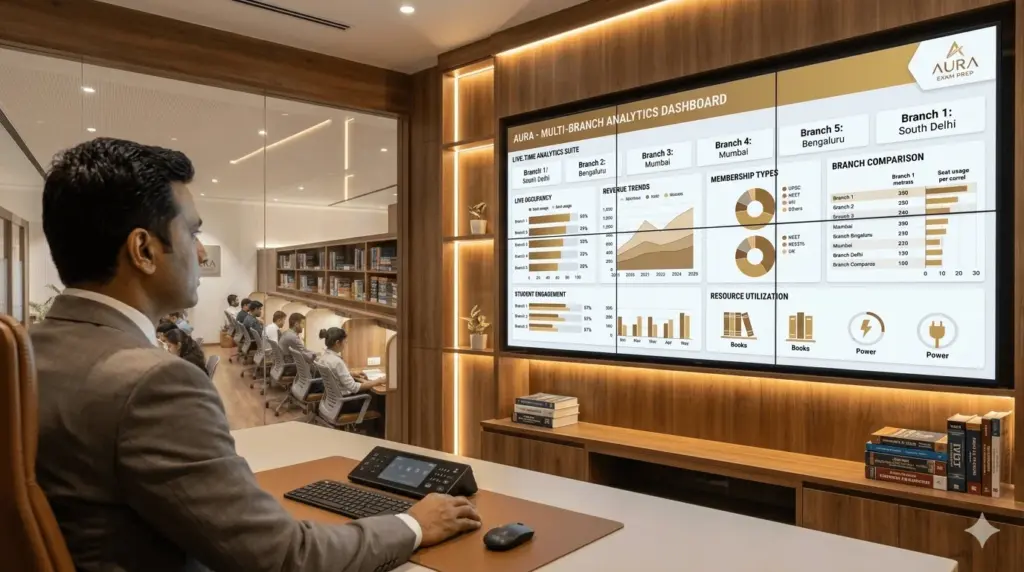
Centralized management simplifies operations as your business expands.
Develop Future Leaders
As your business grows, you can’t personally solve every problem.
Train your team to:
- Welcome students professionally.
- Handle inquiries confidently.
- Resolve basic complaints.
- Follow SOPs consistently.
- Maintain cleanliness standards.
Strong teams allow founders to focus on strategy instead of daily firefighting.
Continue Investing in Student Experience
Expansion should never reduce quality.
Students don’t care how many branches you own.
They care about their experience.
Continue improving:
- Chairs
- Lighting
- Internet
- Air conditioning
- Cleanliness
- Study atmosphere
Every branch should feel like your best branch.
Marketing Becomes Easier
Once your first location has built a good reputation:
- Students recommend new branches.
- Google Reviews increase trust.
- Social media has more content.
- Existing members create referrals.
Brand recognition lowers customer acquisition costs over time.
Common Scaling Mistakes
Avoid these mistakes:
❌ Opening multiple branches too quickly.
❌ Reducing quality to save money.
❌ Hiring staff without proper training.
❌ Operating without SOPs.
❌ Ignoring customer feedback.
❌ Expanding with weak cash flow.
Growth should strengthen your business—not stretch it beyond its limits.

Student satisfaction remains the foundation of every successful expansion.
The Future of Self-Study Libraries
The self-study library industry is becoming more competitive each year.
Students now expect more than just a quiet room.
They expect:
- Comfortable environments
- Professional management
- Online communication
- Digital payments
- Fast support
- Transparent memberships
- Modern technology
Libraries that continue adapting to these expectations will remain competitive.
Those that don’t may struggle, regardless of how long they’ve been in business.
Final Success Checklist
Before considering expansion, ask yourself:
Operations
- ✅ Daily systems run smoothly.
- ✅ Staff follow SOPs.
- ✅ Maintenance is consistent.
Students
- ✅ High occupancy.
- ✅ Strong renewal rates.
- ✅ Positive Google Reviews.
- ✅ Regular referrals.
Financial
- ✅ Stable monthly cash flow.
- ✅ Working capital available.
- ✅ Expansion budget prepared.
Branding
- ✅ Professional identity.
- ✅ Consistent student experience.
- ✅ Strong local reputation.
If you can confidently check these boxes, you’re in a much stronger position to grow.
Frequently Asked Questions
How much investment is required to start a self-study library?
The investment depends on factors such as your city, property size, number of seats, and the quality of interiors and facilities. Instead of focusing on the lowest possible investment, plan a budget that delivers a comfortable and professional study experience.
Is the self-study library business profitable?
Yes. A well-managed library with good occupancy, strong student retention, and controlled operating costs can become a profitable recurring-revenue business.
How many seats should I start with?
There is no universal number. Start with a capacity that matches local demand and allows comfortable spacing. Avoid overcrowding simply to increase seat count.
Should I compete by offering the lowest price?
No. Competing only on price reduces profitability. Focus on providing a better experience through comfortable seating, cleanliness, reliable facilities, and professional management.
What is the biggest mistake new library owners make?
Opening a library without validating demand. Successful founders research their market, visit competitors, and understand student expectations before signing a lease or investing in interiors.
Is library management software necessary?
While a small library can begin with manual systems, software becomes increasingly valuable as your business grows. It helps manage memberships, seat allocation, renewals, payments, attendance, and reporting more efficiently.
Conclusion
Starting a self-study library is not just about opening another business—it’s about creating a space where students can pursue their ambitions with focus and confidence.
The libraries that succeed over the long term are rarely those with the lowest prices or the most expensive interiors. They are the ones that consistently deliver a professional, comfortable, and distraction-free environment.
Throughout this guide, you’ve learned how to:
- Research demand before investing.
- Choose the right location.
- Plan your investment wisely.
- Design a productive study environment.
- Price your memberships for sustainable growth.
- Attract your first 100 students.
- Build systems that improve daily operations.
- Scale your business without compromising quality.
If you approach each of these steps with patience and a commitment to continuous improvement, you’ll be building more than a library—you’ll be building a trusted brand that students rely on throughout their academic journey.
Remember:
Students don’t remember the cheapest library. They remember the one where they achieved their goals.
Make your library that place.
Continue Your Learning with SeatWise Library Academy
This guide is the foundation of the SeatWise Library Academy.
To explore each topic in greater depth, continue with these detailed guides:
- SWA-002: Market Research for Self-Study Libraries
- SWA-003: Choosing the Perfect Library Location
- SWA-004: Investment & Budget Planning
- SWA-005: Interior Design & Furniture Guide
- SWA-006: Pricing Strategy for Maximum Profit
- SWA-007: Marketing & Getting Your First 100 Students
- SWA-008: Library Operations & Management
- SWA-009: Scaling Your Library Business
Together, these articles form a complete knowledge base for anyone who wants to build and grow a successful self-study library business.